Author: Euan Withersby
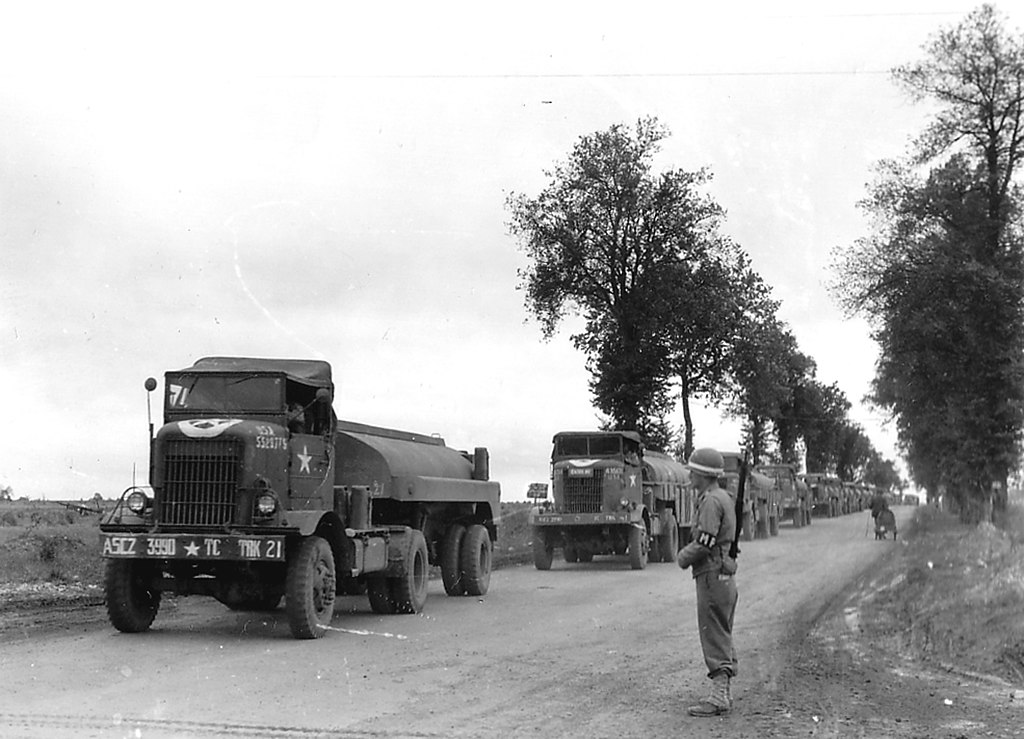
So what can historians, model makers and vehicle enthusiasts learn from US Army Quartermaster Truck Company bumper markings? Well, the obvious answer is the unit and who it belonged to. That’s a pretty good start and can be no mean feat in itself with the many variations that can be seen in wartime photos.
Sometimes, though, they can tell us a bigger story. In this case, it’s the story of how responsibility for transport passed partially from the Quartermaster Corps to the Transportation Corps during the Second World War told through the addition and subtraction of a couple of letters on a bumper.
The 3865th QM Truck Co.
In early June 1944, the 3865th Quartermaster Truck Company (Colored) was based at Maghull, Lancashire. Led by Captain P.T. Sturgis with four other officers and with 150 Enlisted Men. There will be a separate piece about racial segregation in the US Army, but ‘Colored’ was the official designation for units staffed by Black troops, often led by white officers with varying degrees of competency (see the report on the ‘Battle of Bamber Bridge’, Judges Advocate General Corps Holdings and Opinions, Vol. 3, Page 141 ). The 3865th were allocated to Advance Section, Communication Zone (ASCZ) for the invasion.
This information comes from the European Theater unit summaries, so without any supporting evidence there is no way of knowing directly what type of vehicles this unit had.
The 3886th QM Truck Co.
This unit we know slightly more about in relation to equipment. The 3886th QM Truck Co was based in Ledsham, Cheshire, England in the run-up to D-Day (April – June 1944). We do know something about the vehicles they operated, as a CCKW (Truck, 2 1/2 ton, 6×6) 750 gallon tanker from the 3886th resides in the Quartermaster museum at Fort Gregg-Adams. These tankers were stripped from QM Gasoline Supply Companies in early 1942 and the bulk transportation of fuel handed over to the Transportation Corps.
Vehicle markings – AR850-5
Let’s check out what Army Regulations 850-5 say about the markings. We’ll look at this in the context of US Army truck company bumper markings. There are four components to the number markings:
First group-Second group Allied Star Third group-Fourth group
First group
The first group will designate the smallest appropriate unit listed below in accordance with the following code:
This can be any unit formation. There is a standard list, but then any non-conflicting letters combinations can also be used. There are pictures of SOS (Services of Supply) and SOS’ parent organisation, ASF (Army Service Forces) in the first group on unallocated vehicles. Alternatively, there are photos showing WBS (Western Base Section – an administrative area mainly covering the west of Britain pre-D Day) on a truck in Cherbourg. Once a unit was allocated to the appropriate formation, the first group could show 1A (First Army) for example or, like the 3865th, ASCZ (Advance Section, Communications Zone).
Second group
The second group will designate separate regiment, separate brigades; groups, separate battalions, or separate companies, and similar units by appropriate number or symbol, followed by arm or service in accordance with abbreviations listed below. When indicating headquarters and headquarters companies or special companies of units identified in first group, the second group will consist only of the letter “X.” When indicating brigades, the numeral will be underlined.
‘…separate companies…’ is the key here. QM Truck Companies were separate companies and could be attached independently to higher level units such as an Army or a functional organisation such as the Army Service Forces. This group consisted of the company number (e.g 3865) followed by the arm of service (Q – Quartermaster).
This is also where confusion starts to creep in as later in the war, Q TC as arm of service can be seen, then just TC. What’s going on here? On establishment of the Transportation Corps in 1942, they took over shipping and associated port units from the Quartermaster Corps. Although the TC didn’t acquire responsibility for motor transport from the QM officially until 1946, they were given the mission for the invasion of Europe of:
all motor transportation connected with port clearance, static interdepot operations, and line-of-communications hauling
Ruppenthal, R.G. (1953) Logistical support of the armies. Washington: Office of the Chief of Military History, Dept. of the Army. Page 315
As a result, although many truck companies were established as Quartermaster units, they were now assigned to the mission of the Transportation Corps and came under the latter’s provisional control. Ruppenthal, in the official history of logistics in the European Theater, notes that “…many trucks continued to carry the designation “QM Truck Company (TC)” for some months.”
It is therefore a common misconception that TC stands for Truck Company, in fact the mission of the Transportation Corps and the letters ‘TC’ being in that second group should give it away, being in the arm of service position. In fact, confusion arises as many photos show xxxxQ TC, the TC has been added at a later date wherever it would fit – often on the wrong side of the bumper.
Third group
The third group will designate companies and similar organizations by letters in accordance with the following code: [list of letters omitted, these had expanded significantly by late WW2]
The third group is TRK for our Truck Companies. But this is about designating a company, not a vehicle type. So, the jeep (Truck 1/4 Ton 4×4) assigned to a platoon of a truck company should also carry TRK. Headquarters would have displayed HQ as the third group. Generally, the HQ consisted of a small number of vehicles: one jeep (Truck 1/4 Ton 4×4), one Dodge Weapons Carrier (Truck 3/4 Ton 4×4) and two CCKW trucks.
Fourth group
The fourth group will designate the serial number of the vehicle in normal order of march within the organization to which it is assigned. Vehicles assigned to any headquarters will be combined for purposes of numbering with those of the appropriate headquarters company or similar organization, and will be given the smaller serial numbers used therein.
This is easy, it’s a number for each of the 48 trucks and three 1/4 ton trucks (jeeps) within the company (excluding HQ, who had their own number series). AR850 implies that breaking down Army Tables of Organisation and Equipment (T/O&E) into a logical order of March by vehicle type would mean a specific set of numbering. For instance, that 1st Platoon’s jeep would be TRK-1 and the platoon’s trucks would be TRK-2 to TRK-17. That doesn’t seem to be the case in practice and numbering could be fairly random.
Vehicle markings
3865th Truck Company
The following are all possible variations of markings for the 3865th:

ASCZ-3865Q * TRK-14
ASCZ-3865Q TC * TRK-14
ASCZ-3865Q * TC TRK-14
ASCZ-3865TC * TRK-14
Depending on when vehicles were assigned (there were frequent shortages of equipment in the run-up to D-Day), a mixture of bumper markings might be seen.
3886th Truck Company
Thanks to the QM Museum, we do know what the 3886th marked at least one of their trucks. This is ASCZ 3886 * TC TRK 12 – Oddly the TC is seemingly in the third group (although without knowing where the hyphens are, it’s difficult to say). This can be seen on a number of vehicles as there was insufficient space for nine characters on the left hand side of the star as well as the additional TC. This can be seen in the photo at the top of this page.
As an aside, the scale model company Tamiya produce a 1/35 scale model kit of a jeep. Included in the kit are markings for the 3886th Truck Company. This is shown as ASCZ-3886TC * TRK-2. As can be seen from this article, this is correct in all respects for a vehicle in the Advance Section, Communications Zone in Normandy, 1944. Find out more about the history of a specific Jeep in this build review of the Tamiya Jeep kit. Interestingly, Tamiya’s kit of the standard GMC 2 1/2 ton 6×6 truck also features the 3886th in its decal options. This doesn’t mean that either this or the QM museum example is wrong, it was possible to have various vehicles in different platoons or re-equipping units with different equipment depending on the task at hand.
Conclusion
In conclusion, it’s easy to be misled by something that happens to carry the same letters that you’re expecting to see. TC means Transportation Corps, not truck company. The latter is indicated by TRK. As statisticians say, correlation does not necessarily equal causation.
Something as simple as evolving bumper markings may look like nothing, but reveals more about the history of the division of functions between the Quartermaster Corps and the Transportation Corps than might otherwise have been realised.